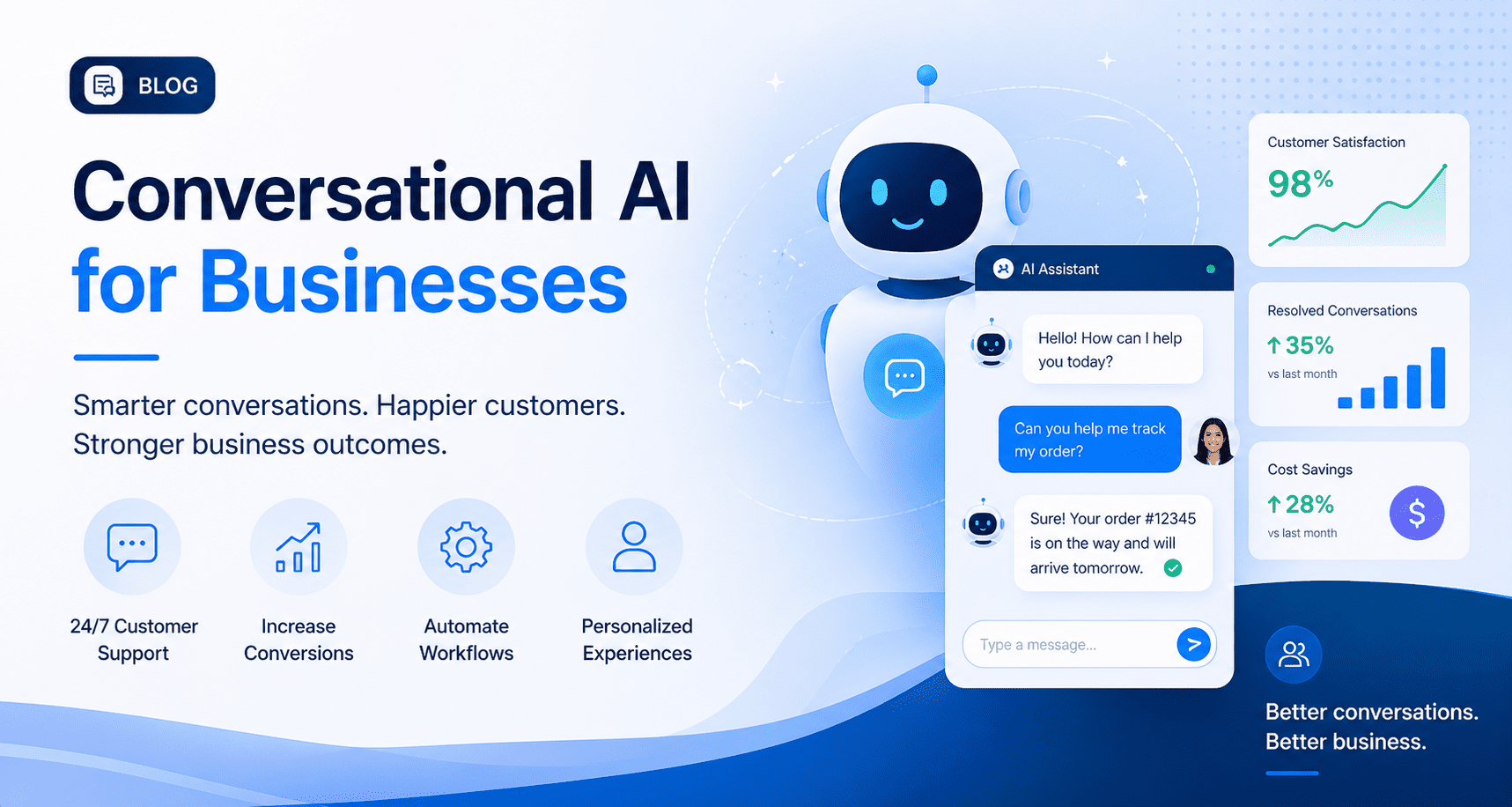
Not long ago, business websites behaved like digital brochures—quiet, static, and waiting to be explored. Now they can talk. Users no longer want to browse; they want to ask questions and receive immediate answers. Conversational AI for businesses is driving this change. It is a combination of technologies that connects human intent and machine intelligence, allowing businesses to engage in a natural, responsive, and personal way. From basic chatbots to sophisticated, context-aware systems that use natural language processing and machine learning to understand intent and respond in a human-like manner, conversational AI has come a long way. And it is making a difference: the conversational AI market is expected to grow from $17.05 billion in 2025 to $49.9 billion by 2031, according to the MarketsandMarkets report. In this article, we’ll look at what conversational AI is, why it’s important, how it’s being used, and how businesses can use it.
What is Conversational AI?
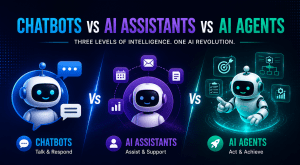
At its core, conversational AI combines Natural Language Processing (NLP), Machine Learning (ML), and Large Language Models (LLMs) to simulate human-like dialogue. It’s not just about responding — it’s about understanding intent, retaining context across a conversation, and generating replies that feel natural rather than robotic. Here’s where it gets interesting: most people confuse it with traditional rule-based chatbots. Those older systems work like a decision tree — they match keywords to scripted responses. Conversational AI, on the other hand, “comprehends” meaning. It can follow the thread of a conversation, pick up on sentiment, and even offer proactive suggestions before you’ve finished asking.
Modern-day conversational AI drives everything from virtual assistants like Siri to smart customer support systems — processing complex queries, crafting tailored responses, and learning after every interaction. It is not a smarter chatbot. It’s a fundamental change in the way humans and machines interact with each other.
Why Conversational AI Matters for Businesses?
The nature of customer expectations has changed — and there’s no going back. Currently, people are used to instant answers, 24/7 availability, and a more personal conversation. And for businesses to meet that bar using only human teams is not well-behaved or sustainable. This is where conversational AI comes in — not a gimmick but an actual need for the business. The McKinsey report, released in late 2025, showed that 88% of the businesses were using AI in at least one function (in many cases, service operations such as customer care). Gartner, Inc. has found that 85% of customer service leaders have begun piloting a customer-facing conversational generative AI (GenAI) solution by 2025. These are not experimental pilots — they are strategic investments.
According to the report on customer service performance metrics, trends, and strategies in 2025 by freshworks, AI solutions lower costs, boost agent productivity, and speed up resolutions, resulting in AI-related gains such as 42.7% improvement in response time and 35.2% improvement in resolution time in software companies. But what’s less discussed is how conversational AI is increasingly becoming the face of digital commerce – the first step in the customer journey. From password resets to ticket bookings to diagnosing problems at low tide, these systems provide smarter and consistent service – without waiting.
In today’s fast-paced digital world, a single bad experience can mean losing a customer forever. That’s why conversational AI is no longer just a nice-to-have; it’s a must-have for businesses that want to stay ahead of the game. It’s about creating a trusted experience that feels personal and human, even when you’re dealing with a huge number of customers.
And the best part? You can do all this without having to hire more staff.
How U.S. Businesses Are Scaling with Conversational AI?
At the forefront of conversational AI development, the United States continues to lead in adoption, thanks to robust enterprise investments and tech-savvy consumers. Data from the U.S. Census Bureau Business Trends and Outlook Survey shows that in late 2025, AI use in U.S. businesses stood at roughly 18%, with more than 20% expected by mid-2026. The adoption rate is much higher when considering the number of employees affected – some 78% of workers are employed in companies that have adopted AI, signalling high levels of adoption by large corporations. Industry trends show that some sectors are leading the way: the information and technology sector has adoption rates of up to 30% – well above the national average. And previous Census data shows that AI is rapidly permeating other business areas, including customer service, automation, and analytics. According to Grand View Horizon, the market for conversational AI in the U.S. will grow to US$ 7,750.1 million by 2030.
These data reveal a clear pattern: conversational AI is being adopted beyond pilot projects – particularly in customer-centric and knowledge-based industries – in the U.S., placing it as a core element of digital business strategy.
Key Business Benefits of Conversational AI
1. 24/7 Availability Without the Overhead
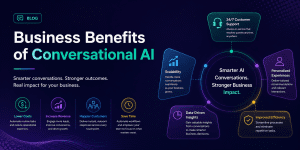
Customers aren’t constrained by working hours – and neither is conversational AI. Conversational AI is always available, always up to date, and never gets tired or distracted. This 24/7 responsiveness boosts customer experience and eases the burden on agents.
2. Lower Operational Costs, Higher ROI
It’s costly to maintain large support staffs. Conversational AI drastically cuts these costs. With conversational AI, IBM answered 70% of queries with a digital assistant, increased the resolution rate for complex issues by 26%, increased customer satisfaction by 25 points, and has saved USD 165 million in operating costs since 2022. Businesses are also seeing a 3.50:1 return on investment in AI-powered customer services. Reduced escalations allow human resources to prioritise other tasks and complex customer issues – making the operation more efficient.
3. Effortless Scalability
Human agents are not scalable – they can’t handle surges. Conversational AI can instantly scale to handle thousands of conversations, maintaining response times and quality. This is crucial for large organisations.
4. Personalization Through Machine Learning
Today’s systems learn. Basing interactions on past conversations and purchasing patterns, AI personalises interactions with users, presenting relevant products, services and recommendations at the right time.
5. Sentiment Analysis & Proactive Insights
AI-powered conversations recognise sentiment in real time – pinpointing unhappy customers. This real-time sentiment analysis speeds up the process of having to sift through thousands of conversations to extract insights.
6. Strengthened Brand Loyalty
Seamless, personalised, and reliable interactions foster trust. When customers know that you understand and assist them, always, they become loyal.
Top Conversational AI Use Cases in Industry
1. Customer Service & Support
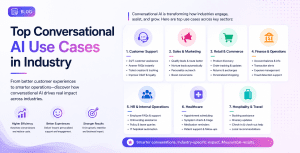
Conversational AI in the customer service industry has enabled 24/7, multilingual customer support through websites, mobile apps, and social media. It can respond to simple queries, resolve issues and even analyse data to predict issues. This is a big development with quicker response times, consistent and personal interactions.
2. Sales & Marketing
In sales, conversational AI is the human-like sales rep to engage leads in real-time, qualify opportunities, and schedule meetings. It also scores leads and advises on an action plan. In marketing, it uses data to offer real-time marketing insights and content personalisation, and improve engagement. AI-powered sales platforms are helping businesses to improve conversion rates and sales time.
3. Retail & Commerce
Conversational AI is a digital sales associate for e-commerce. It makes recommendations, tracks orders, and provides interactive help during the purchase process, thus reducing cart abandonment rates. It also offers inventory and product suggestions to improve the customer experience and increase revenues.
4. Finance & Operations
Conversational AI offers safe banking, fraud prevention and invoicing in the banking sector. It simplifies transactions while keeping them secure, enabling faster and more convenient transactions.
5. HR & Internal Operations
In the workplace, AI can be used to handle HR-related queries, onboarding new employees and IT support. This increases efficiency and productivity.
6. Healthcare Applications
Conversational AI keeps up with doctor appointments, reminds patients to take their meds and provides information – freeing up time and improving the overall experience for patients without impinging on care.
7. Hospitality and Travel
It provides travellers with personalised itineraries and experiences, and even schedules appointments and hotel stays – turning travel more pleasant.
How to Successfully Use Conversational AI?
Using conversational AI is both a technical and strategic decision. When done right, it’s an investment. If you do it wrong, it irritates customers and costs you money. Here’s how to do it right.
1. Start Small and Focus on Impact
The key is not to boil the ocean, but to boil a cup of water. Prioritise “quick wins” in areas where AI will make a large difference, such as customer service or lead scoring. Setting clear goals is essential: businesses with AI goals are more likely to succeed.
2. Prioritize Data Quality
Conversational AI is only as intelligent as the underlying data: It’s important to train the models to understand domain-specific, relevant, and good-quality data to give an appropriate response. Poorer quality data leads to a worse experience: an expectation that consumers have and businesses can’t ignore.
3. Adopt a Hybrid Approach
The best AI is human AI. This hybrid approach (using AI to answer basic questions and to direct complex questions to a human agent) gives efficiency and the human touch. It’s critical to earn trust and delight customers.
4. Continuously Monitor and Optimize
It doesn’t end there. Regular monitoring of key performance indicators like issue resolution, engagement, and satisfaction will enable performance optimisation. Machine learning allows AI bots to improve their accuracy, and modifications keep bots up to date with customers’ expectations.
5. Ensure Transparency and Trust
Customers appreciate honesty. Transparency and explanation that users are engaged with AI sets the right expectations. It also prevents negative surprises and increases acceptance. Nextiva claims 81% of companies with mature AI initiatives report positive business outcomes, and it’s not enough to adopt AI; it’s how you use it and how you keep improving it that counts.
The Future of Conversational AI
1. Reactive to Proactive
Today’s AI responds. Tomorrow’s AI anticipates. Notes’ future systems will be anticipatory – reaching out to provide solutions, recommendations, or danger signs based on a profile and predictive analytics.
2. Agentic AI
It’s not about chat, it’s about action. Agentic AI can autonomously take on complex tasks: it can do independent research, make decisions, and take action. Deloitte expects 25% of companies that use generative AI will have agentic pilots by 2026 and 50% by 2027.
3. Voice, Emotion & Multimodal Intelligence
Future systems will be text, voice, and video input, with tone and emotion recognition, and voice, video, or chat output. Emotional recognition will become standardised, rather than an add-on, and interactions will be more human and empathetic.
4. Hyper-Personalisation at Scale
With a better understanding of customers, the way we interact with AI will become more personalised – not only at a name level, but at a behavioural, preference, history, and even state of mood level. Mass personalisation becomes a reality.
5. Governance, Ethics & Trust
With great power comes great responsibility. And this is particularly true for those using artificial intelligence development technology. They will need to be extremely transparent about how they use data, ensure that people’s private data is safe, and use AI responsibly. It’s also interesting to note that 30% of the organisations not using AI are already developing their governance. This indicates that many companies believe it’s important to have good governance established before they begin to use AI. As companies start to use AI more with customers, this will need to be considered.
In Short,
Conversational AI is no longer a trend; it’s here to stay. It’s essential for business efficiency, customer retention, and great returns on investment.