How audiences consume content has changed dramatically. Traditional TV, with its set schedules and limited viewing options, is slowly being replaced by on-demand streaming. Today, viewers expect instant access to media on all devices. This shift prompts media companies to rethink how they distribute, engage, and monetize. As a result, OTT (Over-the-Top) platforms are now central to the modern media landscape. The growth of the OTT market highlights this change. This article explores about the OTT platform development for media companies, key features, technologies, and strategic insights.
According to Statista, the global revenue from OTT video is expected to reach about US$352.96 billion in 2026, with an 8.14% compound annual growth rate (CAGR), and by 2030, that figure could rise to nearly US$482.76 billion. In this increasingly competitive environment, media companies are investing more in their own OTT platforms. This helps them boost brand ownership, connect directly with audiences, and create profitable revenue sources
Understanding OTT Platforms and Their Business Value
An OTT (Over-the-Top) platform is a digital streaming service that delivers video content directly to viewers via the internet, bypassing traditional cable, satellite, or broadcast networks. That flexibility has fundamentally changed audience behaviour. The viewer decides what to watch, when to watch it, and on which screen. Whether it be entertainment and sports or news and education, OTT has changed the way people access media from set times to on-demand experiences.
There are four major types of OTT Models:
- Subscription Video on Demand (SVOD) – a recurring fee for unlimited access, such as Netflix or Apple TV+
- AVOD (Advertising Video on Demand) — free content that is supported by ads, such as YouTube and Pluto TV
- Pay per title for video access (TVOD), like Amazon Prime renting a film.
- Hybrid models — the mix of the above, which are being increasingly adopted as platforms strive to generate revenue and reach.
This is not just a new channel for media companies; it is a new approach to the audience. A July 2025 report from the Pew Research Center indicates that only 16% of Americans aged 18-29 are still cable or satellite subscribers. The media channels that are most critical to the audience have shifted. Creating an OTT platform is about meeting them where they are, on your conditions, not the cable operator or aggregator’s.
OTT Platform Development for Media Companies in the USA
The U.S. media landscape is changing drastically as audiences are moving away from television to streaming services. Nielsen found that in the U.S., streaming accounted for 44.8% of total television viewing, surpassing cable and broadcast viewing combined, as part of this trend. Media companies can capitalize on this transformation by developing their own OTT platforms that give them greater control over content, user experience, and revenue. On a global scale, the United States will see the most revenue, at US$154.40bn by this year, one of the biggest streaming markets worldwide, according to Statista data. Furthermore, Sambatv.com’s research revealed that streaming has now captured 60% of total TV viewing hours per household in the United States, showing the increasing popularity of on-demand TV.
For media companies, a custom OTT platform also means that you not only own your audience, you also own your data and your revenue — not distributors. The future of the US TV audience is streaming, and now is the time to develop a scalable platform to ensure long-term success.
Core Features of a Successful OTT Platform
- Seamless Multi-Device Experience
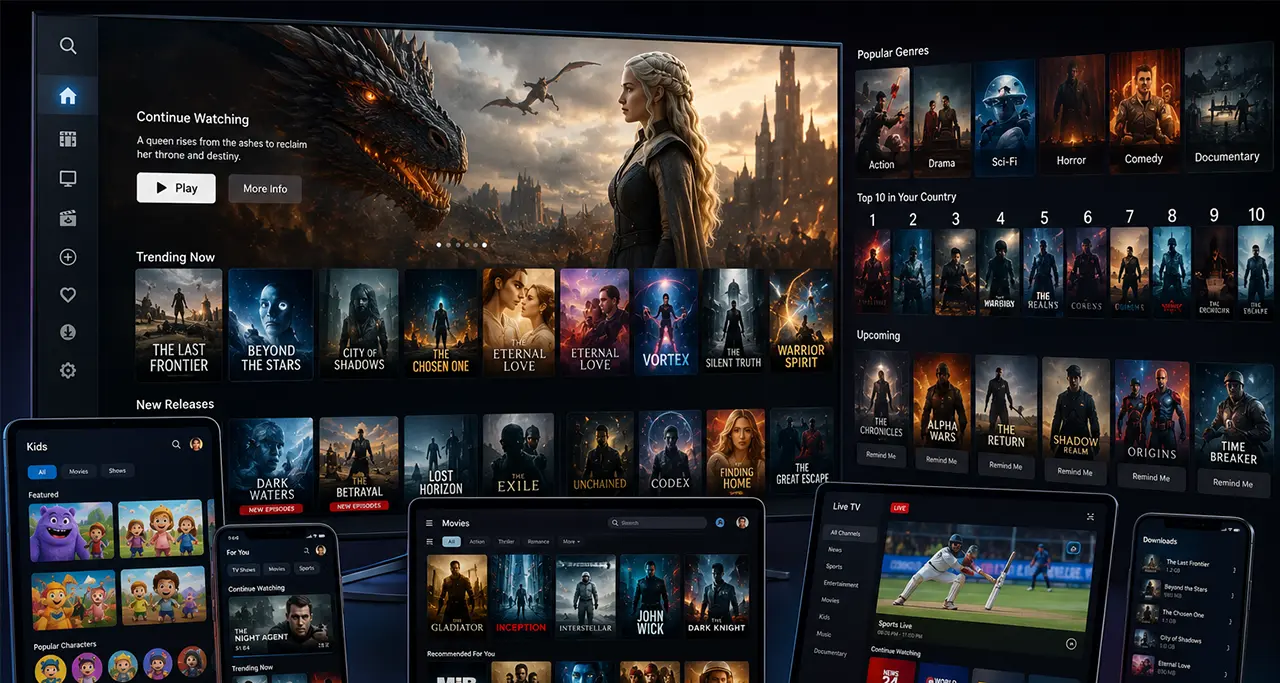
Users can seamlessly switch from their phone to a laptop, tablet, or smart TV without missing a beat. Your platform must be mobile with them. It’s not nice to have, it’s a requirement to have a consistent and responsive interface on all screen sizes. Engagement and retention are much higher for platforms that offer cross-device continuity, such as “continue” where you left off on another screen.
- Personalised Content Discovery
Nobody wants to be forced to scroll a lot. Recommendation engines driven by AI algorithms can synthesize the information of what people have viewed, liked, and engaged with, and the content they are likely to want to watch. Smart discovery is the key to getting viewers to become repeat customers, and Netflix has been utilizing recommendation systems as a key part of its engagement strategy for any OTT platform.
- Robust Content Management System (CMS)
The smooth streaming experience is underpinned by an organised content backend. With a purpose-built CMS, media teams can upload, categorize, schedule, and manage content at scale, without having to depend on engineering support for every update along the way. Greater team publishing and organizing speed equals a more responsive platform.
- Flexible Monetization Infrastructure
One revenue model is one single point of failure. Successful platforms are designed to be flexible, accommodating subscriptions, ad-supported programmes, pay-per-view, and hybrid models. The addition of ad-supported tiers alongside premium ones expanded Hulu’s audience base considerably by giving viewers the option of paying one way or another instead of forcing them to take one.
- Secure Content Delivery and DRM.
Content is the product — protecting it is non-negotiable. Digital Rights Management (DRM) technologies support non-repudiation of sharing and prevent possible piracy, and end-to-end encryption ensures viewer data is protected. Security and data privacy are two of the foremost worries for platform users, which means strong security measures are not only an essential feature but also a sign of trust for viewers (Mogi I/O, 2024).
- Customer Support and Experience
The real value of owning an OTT platform is owning the data. Built-in analytics provide you with content performance data, viewers’ drop-off points, which channels convert, and what makes viewers renew their subscriptions. This is first-party intelligence that no cable network or third-party aggregator will ever deliver — and no one will ever be better equipped to make content and business decisions over time.
- Scalable Streaming Infrastructure
OTT traffic is not consistent; it surges during new releases, live shows, and trendy content. A fully dynamic, scalable cloud-based infrastructure keeps the platform fast and stable when it matters most. The thing viewers remember it for is buffering during a season premiere.
Key Technologies Behind OTT Platform Development
- Cloud Infrastructure
With cloud hosting, OTT platforms can easily scale up. A quiet Tuesday can turn into a season premiere that needs extra servers. Without flexible infrastructure, sudden traffic spikes can cause outages.
- Content Delivery Networks (CDNs)
A CDN is a group of content stored on servers around the world. It can provide video streams from the server closest to the viewer. This results in faster loading times and less buffering—two things that viewers want most.
- Video Transcoding
People do not always watch on the same device or at the same connection speed. Transcoding automatically converts the source video into different resolutions and formats. The platform then adjusts to the viewer instead of making the viewer adjust to the platform.
- Streaming Protocols
Adaptive streaming technologies like MPEG-DASH and HLS control the flow of video data to the screen. They optimize the content’s quality based on bandwidth to ensure smooth playback.
- API-Driven Architecture
APIs serve as a connection between the various parts of the platform, including payment systems, CMS, analytics, and third-party integrations. They help maintain smooth communication and operation among these components.
- Artificial Intelligence & Machine Learning
In addition to making recommendations, AI can evaluate website performance, spot unusual activity, customize user interfaces to their specific preferences, and predict what videos they might watch next on your platform. Netflix reports that its recommendation system alone costs over $1 billion a year in customer churn.
- Data Analytics
Every interaction on the platform provides valuable information. It tracks who saw what, how long they watched, on which device, and where they stopped watching. These details guide all future decisions regarding content and product.
User-Centric Design Principles for Seamless OTT Experiences
- Simplicity First
When a viewer must think about how to find something, then the design has failed already. Netflix was one of the reasons for its success because it created a seamless interface from login to viewing, and the menus and navigation were streamlined.
- Intuitive Personalisation.
There should be no need to search the website for something that viewers are looking for; the platform should have an idea of it. Recommendations based on viewing history and behavior, powered by AI, create a more personalized experience than traditional recommendations and boost the chances of users sticking with the platform and spending more time on the app.
- Accessibility by Default
Subtitles, audio description, voice control, and WCAG compliance are not a luxury, but the essence of a platform that is accessible to everyone. For example, accessibility is added not as a feature; it is a fundamental aspect of Apple TV+’s design.
- Consistency Across Devices
The viewer should not feel as if they’ve opened a whole different app when switching from a phone to a smart TV. DisneyPlus knows one consistent and recognizable experience across all screens – and that consistency, unobtrusively fosters trust.
- Speed and Responsiveness
The opposite of engagement is buffering. Optimized compression, adaptive streaming, and CDN infrastructure ensure smooth playback on any device and connection speed.
OTT Platform Development for Media Companies: From Idea to Launch
Most streaming platforms don’t fail because of bad content. They fail because the build wasn’t planned well enough before the first line of code was written. Here’s how the process works.
1. Identifying a niche before you monetise is the first step.
Two questions to ask before any design or development starts: Who is this for, and how does it make money? All the technical decisions that come after are affected by the choice of SVOD, AVOD, TVOD, or hybrid models. If you do it wrong from the start, it will be costly to correct it later.
2. Carry out market and competitor research.
Knowing the existing features and their shortcomings avoids the creation of unnecessary features. Niche sites like fitness, education, and religious in nature are always better at retaining subscribers and achieving higher LTV compared to broad entertainment services.
3. Planning the Architecture & Tech Stack
That’s where the cloud infrastructure, the CDN selection, streaming protocols, and API structure are determined. This phase becomes an issue of scalability when the traffic increases if rushed.
4. UI/UX Design
Wireframes and prototypes are not part of the development process but precede it. The initial user experience regarding navigation and layout will either keep them using the site beyond the initial session or encourage them to depart.
5. Development and Integration
Coordinated team built parallel for the front-end, back-end, video player, CMS, payment gateways, and DRM; followed by integration and testing.
6. Quality Assurance Testing on Devices
There must be independent validation of performance on mobile, desktop, smart TV, and tablets. You want to make a good impression on launch day – and you don’t want it to be buffering.
7. Launch—Then Iterate
It’s not the end of the race to go live. Post-launch analytics provide insight into what viewers are actually doing – informing every improvement thereafter.
How to Choose the Right OTT Development Partner?
The right OTT development partner offers more than just technical expertise. You need someone who has real media and entertainment experience, end-to-end ownership from the architecture through after-launch support, and understands streaming-specific challenges such as DRM, adaptive bitrate, multi-device consistency, and monetization flexibility. A good portfolio of working OTT systems will speak volumes more than a sales pitch.
Streamify is designed to offer just that. It offers an all-in-one streaming solution for enterprises, media houses, production companies, and content creators, with fully deployed web and mobile apps, a centralized admin portal for content and user management, and a cloud-native AWS-based architecture that scales securely with your audience.
The Future of OTT Platform Development for Media Companies
OTT is no longer an alternative channel — it’s becoming the primary one. For media companies, the question is no longer whether to invest in streaming, but how much control they want over the experience, the audience, and the revenue it generates. Custom platforms combine the three. The organizations that create for audiences where they are going, not where they have been, will control that relationship for the long haul.
Looking to create your own? Discover Streamify and get ready to begin your streaming adventures now!