
Financial Document Processing Using AI
Client: Reducing Manual Work in Finance with AI
 Overview
Financial data of organizations is often scattered across invoices, proposals, bills, receipts, etc., making it extremely difficult to interpret. We developed a financial document processing solution called FinScan, an AI-based, fully secure data extraction and analytics tool to automate the extraction and structuring of financial data from scattered documents. FinScan leverages in-house deployed open-source large language models (LLMs) to interpret unstructured or semi-structured financial documents and convert them into structured, system-ready data. Unlike traditional OCR-based tools, our solution understands contextual data, establishes relationships between parameters, and understands business semantics. FinScan operates within a fully secure environment, ensuring that sensitive financial data doesn’t leave the organization’s infrastructure.
The Case
Organizations across industries typically deal with a lot of financial documents as part of their business operations. These documents could be of several categories, like accounting, auditing, resource procurement, compliance, etc. Filing, sorting, and analyzing these documents often involve:
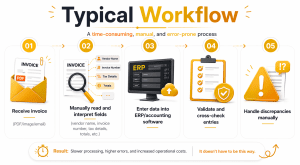
- Manually feeding data from scattered documents into ERP and accounting systems
- Exhaustive, time-consuming verification of extracted data
- High probability of human errors (typos, missing fields, incorrect mapping)
- Significant delays in data processing, especially for larger data sets.
- Compliance risks due to inaccurate or incomplete data capture
 Challenges
Document Variability: For organizations, their financial data could be across several documents of different formats, layouts, and templates, varying with vendor standards. These documents could be in multiple languages, and the currencies could also vary. Scanned documents could also have quality issues like noise, skew, or low resolution.
Complex Data Extraction: Extracting tabular data like line items, corresponding quantities, pricing, etc., and identifying key-value pairs, parameter relationships (tax breakdown vs total), and patterns.
Contextual Understanding: Distinguishing similar fields (e.g., invoice date vs due date), mapping extracted values to a standardized schema, and handling missing or ambiguous data are other key challenges.
Accuracy & Reliability: For financial data processing high precision is required, avoiding hallucinations from AI models and ensuring consistency across documents is critical
Data Privacy & Compliance: Financial documents typically contain highly sensitive business data; cloud-based APIs may violate compliance requirements. A solution that operates fully on-premise or in a controlled deployment is a necessity in this scenario
Scalability: Processing large volumes of financial data in real-time or batch mode, while maintaining platform performance and without compromising accuracy, is another key operational challenge.
 Solution
 Impact
 Get in Touch
Ready to Transform
Your Business?


Send us a Message
We’ll respond within 24 hours